ANSWER VALIDATED
MAKING YOUR BUSINESS THE VERIFIED RESPONSE
Answer Validated provides complimentary AI-readiness assessments, paid written improvements, and optional implementation to clarify how businesses are understood by customers, search engines, and AI systems.
Imagine a service that checks whether your website is genuinely recognized by people, search platforms, and AI tools.
Because today, anything that isn’t immediately clear is quietly passed over.
When a business feels generic online, it’s rarely a quality problem—it’s a comprehension issue.
We examine your site the way modern systems and first-time visitors do, in parallel.
Once finished, your business no longer depends on interpretation.
What you provide, who it serves, and why it matters are expressed in a way that can be recognized, summarized, and considered—rather than ignored.
Results are abundant, but few are defined with authority in context.
AnswerValidated brings the clarity and grounding needed for your service or product to stand as an established choice.
What We do
We work at the answer-visibility level, focusing on how a business is understood rather than where it ranks. First, through a complimentary review, we examine how your website explains what you offer and how that description is interpreted by people and intelligence-driven tools; the exercise establishes whether discrepancies exist.
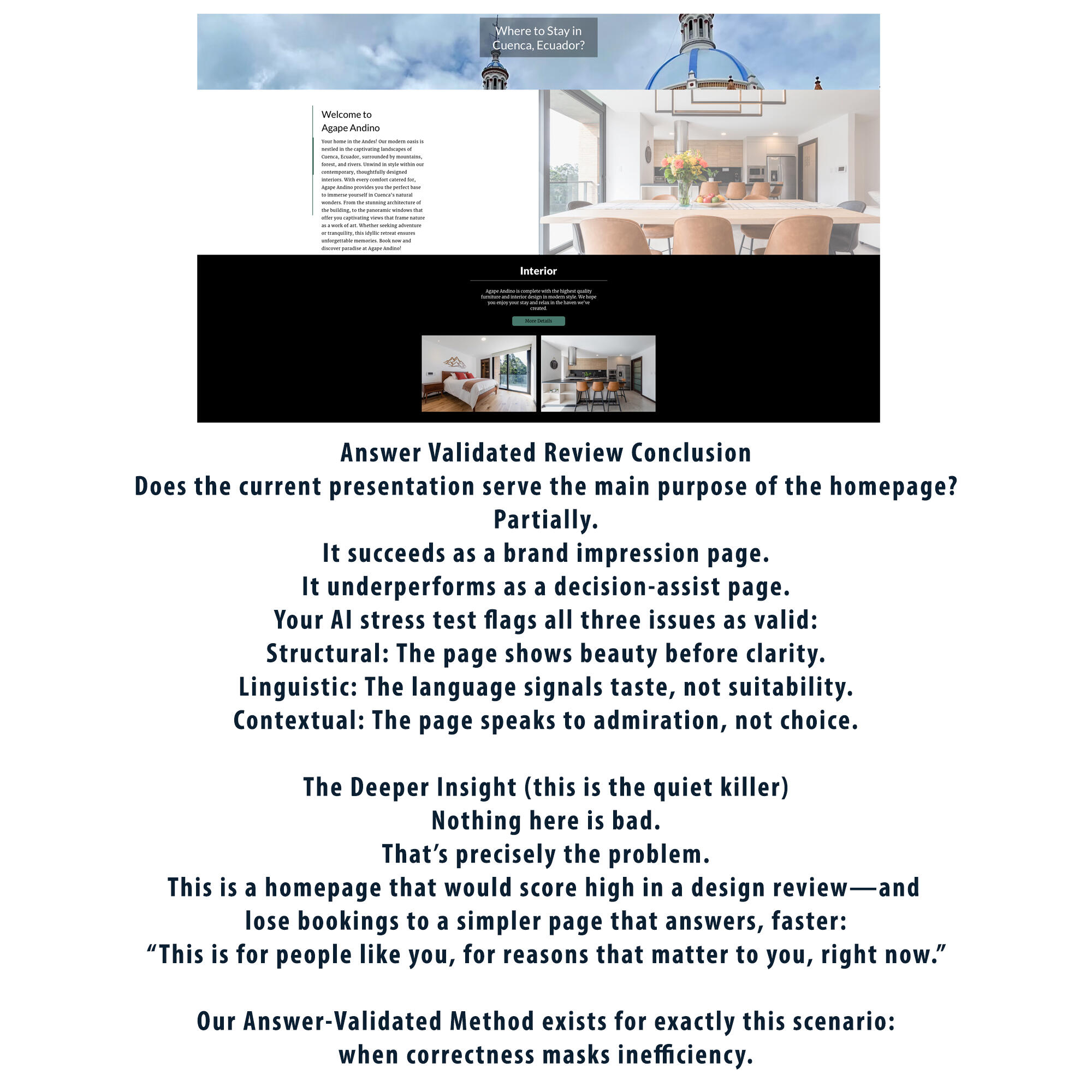
Using AI as a stress test, we identify three common issues:
• Structural — information is present but poorly organized
• Linguistic — wording is vague, overloaded, or imprecise
• Contextual — details are correct but misaligned with decision use
If changes are called for, we offer a paid engagement that delivers a written set of corrections to apply—or we can implement them directly for you.
The goal is straightforward: your service or product should be easy to summarize and clearly convey who it’s for, what it delivers, and why it stands as a validated option in context.
Who This Is For
This is for operators who understand that search and decision-making have changed—and want to stay relevant. If your business performs well offline but appears diluted, generic, or misunderstood online, this service addresses that gap.
Modern search and AI systems no longer check for keywords. They assess whether information is clear enough to rely on. When it isn’t, the business is quietly excluded—no penalty, no warning.
Request a Review
The observational assessment is free of charge and limited in coverage. It is intended to identify interpretation issues, not to provide performance forecasts. It does not include outlined improvements or integration.
Review Sample Snippet - This conclusion is based on a structured Answer Validated Propietary Method AI stress test, evaluating a homepage, across three diagnostic dimensions.
Disclaimer: Our services—at no charge or paid engagement— are performed diligently and in good faith, applying current best practices and professional judgment based on how search and AI-driven systems operate at the time of review. The work is platform-agnostic. Search engines, AI systems, and third-party online engines may change how information is processed or displayed at any time, and we do not control how external systems summarize, rank, or surface content.
What Happens Next
After you submit your website's link, you’ll receive a response within three business days indicating whether changes are worth addressing.
If refinements are necessary, we propose a fee-based service. This can be delivered as a written document of word-by-word adjustments only, or through direct implementation, where we make the changes in your website myself.
Once agreement is signed and funded, our approach moves beyond diagnosis. It focuses on aligning core descriptions, resolving structural and interpretive conflicts, and organizing information so it can be accurately understood, summarized, and evaluated when relevant questions arise.
The Answer Validated Method
The reconfiguration is finite and designed to establish a stable, correct representation that stands on its own once complete.
After our job is done, your business no longer depends on assumptions to be understood. It's clearly defined, consistently interpreted, easier to summarize, and validated when compared side by side.
How your Business Becomes a Validated Answer
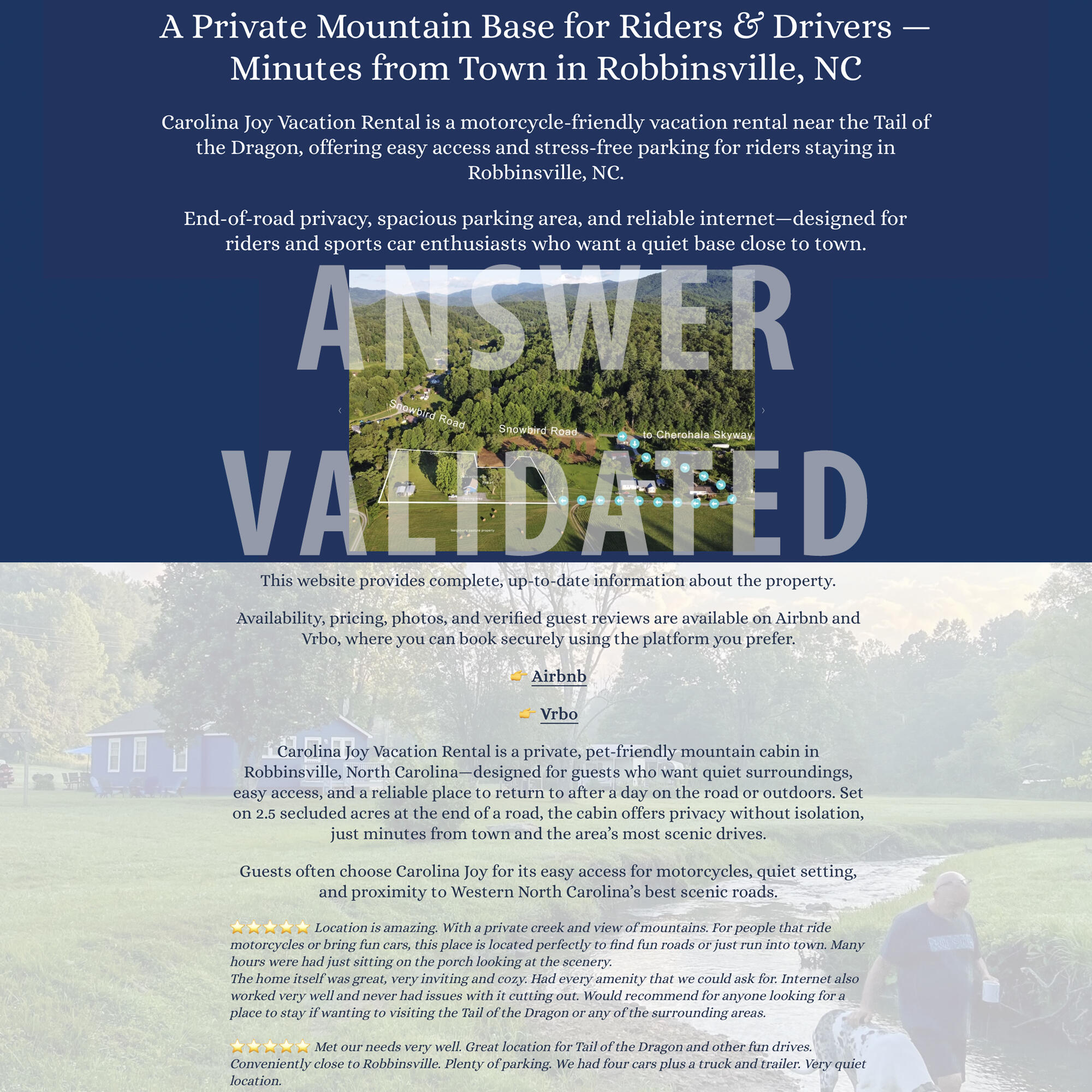
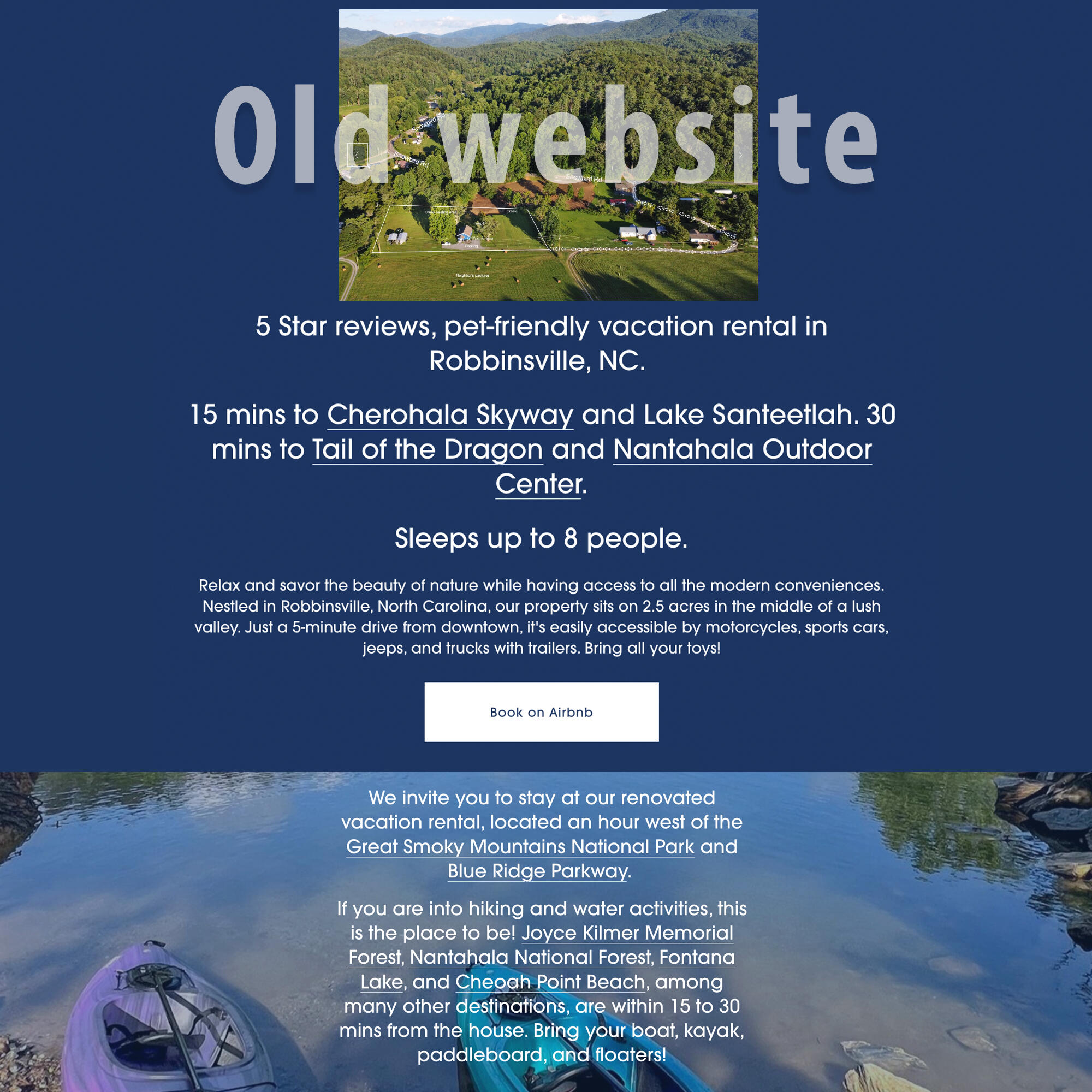
This is what reinforced interpretation looks like. Quiet. Precise. Effective.Before:
A generic vacation-rental homepage.
Features listed. Locations mentioned.
But readers—and show-up systems—had to figure out why this place mattered.
After:
The service didn’t change.
The structure did.
The site was rebuilt around how people actually ask for a place like this:
• riders looking for easy access
• drivers needing parking and privacy
• guests wanting a quiet base close to iconic roads
Abstract categories were replaced with real scenarios.
Vague descriptions were replaced with specific reasons to stay.
Result:
The page moved from “another rental” to a clear, contextual answer that holds up when options are compared.
Be understood. Or be skipped.
This example shows a focused correction within one section. The same validation logic applies across structure, language, and context site-wide.